
KPV is the tripeptide lysine-proline-valine, the C-terminal fragment (residues 11 to 13) of alpha-melanocyte-stimulating hormone, studied in inflammatory-signalling research as the smallest fragment that retains activity in specific assays. In the Celyfe range it appears in one pen only, the KLOW Pen, at 15mg per 3ml cartridge, on sale now. This page covers what KPV is, why the fragment is used instead of the whole hormone, and what it adds to the GLOW set.
What is KPV?
KPV is a three-residue peptide, lysine (K), proline (P) and valine (V), with the formula C16H30N4O4, molecular weight 342.4 g/mol and CAS number 67727-97-3. At three residues it is among the smallest peptides in the Celyfe library, far shorter than the fifteen-residue BPC-157. It corresponds to the last three amino acids, positions 11 to 13, of alpha-melanocyte-stimulating hormone (alpha-MSH), a thirteen-residue peptide hormone.
Researchers work with the fragment rather than the full hormone for practical reasons. A three-residue peptide is simpler to synthesise at high purity and easier to confirm by mass spectrometry, and it isolates the region associated with a given activity without the rest of the alpha-MSH sequence as a variable. The KLOW product page adds that the fragment drops the melanocortin-receptor pharmacology of the full peptide. Studying minimal fragments of larger hormones is a common strategy across peptide research. The guide What is KPV? covers this in more depth.
How KPV is used in the Celyfe system
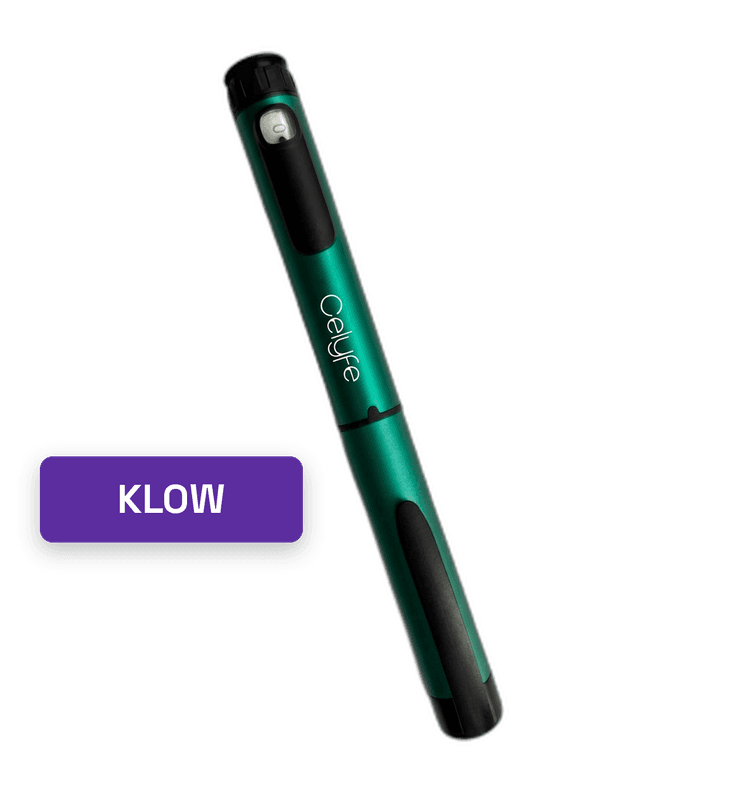
KPV is carried only in the KLOW Pen, where it is the fourth component added to the GLOW set. The KLOW cartridge holds GHK-Cu 75mg, BPC-157 15mg, TB-500 15mg and KPV 15mg, 120mg in total in a pre-filled 3ml cartridge, dispensing 0.400mg of the combined formulation per 0.01ml click across 300 clicks. The K in KLOW stands for KPV.
The addition adds a probe for a pathway family the other three peptides do not cover: inflammatory-signalling models. KPV is a fragment of the melanocortin hormone alpha-MSH, but a 2003 study (Getting et al.) concluded it is unlikely to act through melanocortin receptors. Including it is a formulation choice that lets a laboratory work with all four compounds from one pen, not evidence that the four-compound combination has been studied as a unit. The pen ships pre-mixed. The KLOW certificate is being re-issued and is not yet published, so no KLOW test result is claimed here.
- KLOW Pen: KPV 15mg with GHK-Cu 75mg, BPC-157 15mg and TB-500 15mg, 120mg in total, 0.400mg per click.
- GLOW Pen: the same set without KPV, 105mg in total.
- WOLVERINE Pen: BPC-157 and TB-500 only, 30mg in total.
What the research literature covers
The sources below include two primary papers: Dalmasso et al. 2008 (Gastroenterology), on PepT1-mediated KPV uptake in cell lines and mouse colitis models, and Getting et al. 2003 (J Pharmacol Exp Ther), which dissected the anti-inflammatory effect of the core and C-terminal (KPV) alpha-MSH peptides. The guide describes the published work as cell-culture and mouse-model studies of inflammatory cell-signalling pathways, including NF-kB signalling, a transcription-factor pathway involved in regulating inflammatory gene expression. That research is preclinical and describes findings under laboratory conditions.
KPV is not an approved medicine, and the KLOW Pen is supplied and labelled for in-vitro research use only. Nothing on this page is a claim about effect in a human or animal body.
Handling, storage and quality
The KLOW Pen is a pre-mixed solution: refrigerate at 2 to 8 degrees Celsius on arrival, keep sealed and protected from light, and never freeze. Because the cartridge also carries the GHK-Cu copper complex, dilute into a near-neutral buffer rather than an acid. The batch-specific certificate of analysis confirms identity and purity for all four components. There is no reconstitution step and no bacteriostatic water to source.
Key takeaways
- •Lysine-Proline-Valine (KPV) is a peptide.
- •Library note: Alpha-MSH tripeptide fragment studied in inflammatory-signalling pathways.
- •Carried in: KLOW Pen at 15mg per pre-filled 3ml cartridge.
- •KPV is a regulated compound - this page is educational, not medical advice.
This page is informational and not medical advice. KPV is a regulated compound. Celyfe pens are supplied strictly for in-vitro laboratory research and nothing here is guidance on use in humans or animals.
At a glance
- Class
- Peptide
- Full name
- Lysine-Proline-Valine (KPV)
- Per cartridge
- 15mg
- Format
- Pre-filled 3ml pen cartridge
Role in the library
Alpha-MSH tripeptide fragment studied in inflammatory-signalling pathways.
Used in
Frequently asked questions
Sources
- KLOW Pen (product page)
- GLOW Pen (product page)
- NAD+ Precision Pen (product page)
- Guide: What is KPV?
- Guide: What is the KLOW Pen?
- Guide: How to store research peptides
- Guide: What is a certificate of analysis?
- Guide: Are peptides legal in the UK?
- Compare: GLOW Pen vs KLOW Pen
- Dalmasso G et al. PepT1-mediated tripeptide KPV uptake reduces intestinal inflammation. Gastroenterology, 2008. PMID 18061177
- Getting SJ et al. Dissection of the anti-inflammatory effect of the core and C-terminal (KPV) alpha-melanocyte-stimulating hormone peptides. J Pharmacol Exp Ther, 2003. PMID 12750433
Related peptide compounds