


GLOW Pen vs KLOW Pen: which formulation?
The GLOW Pen carries GHK-Cu, BPC-157 and TB-500 (105mg total). The KLOW Pen is the same three compounds plus KPV (120mg total). KLOW is GLOW with an added alpha-MSH fragment for a four-pathway research set; GLOW is the three-compound version.
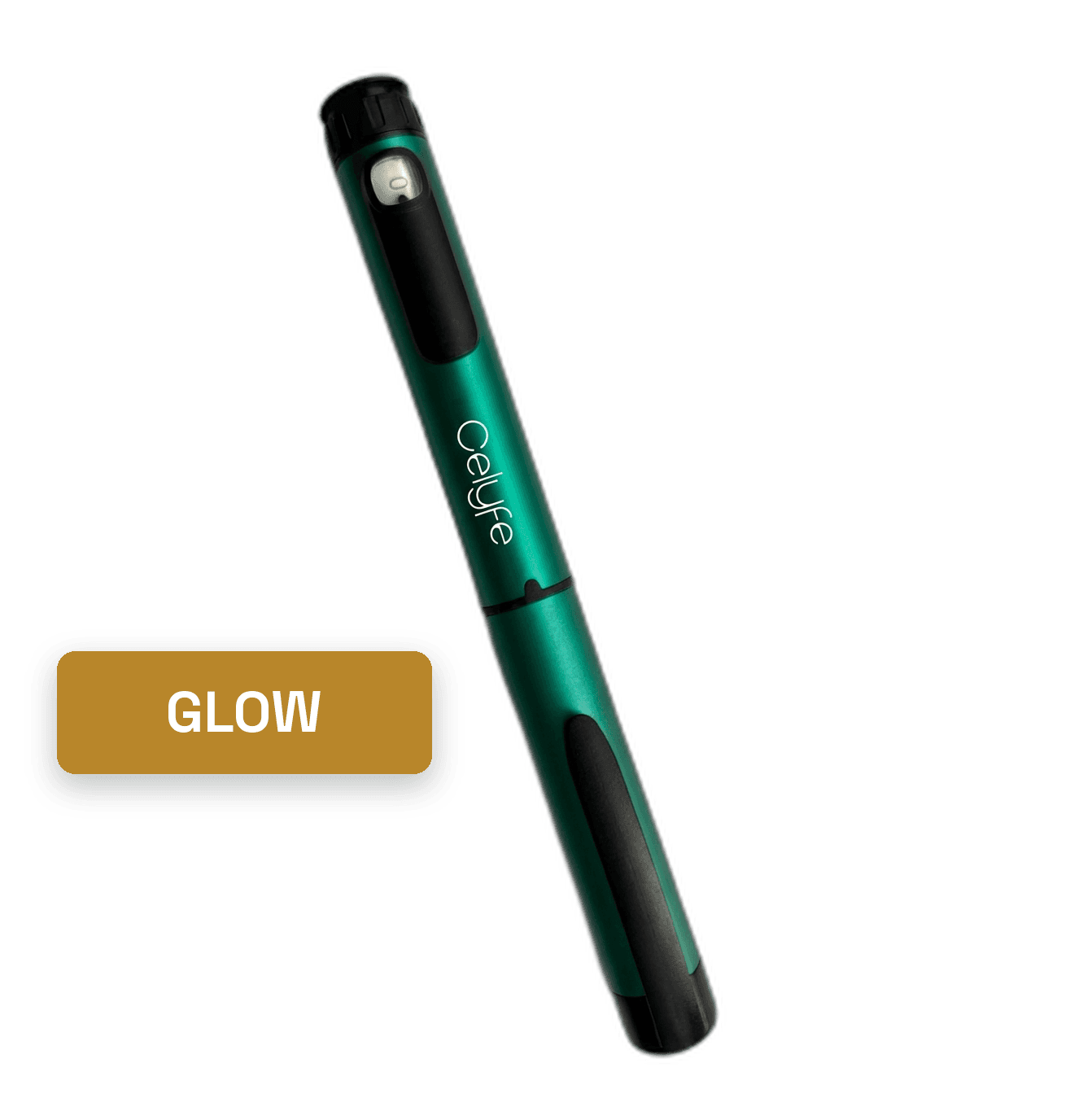
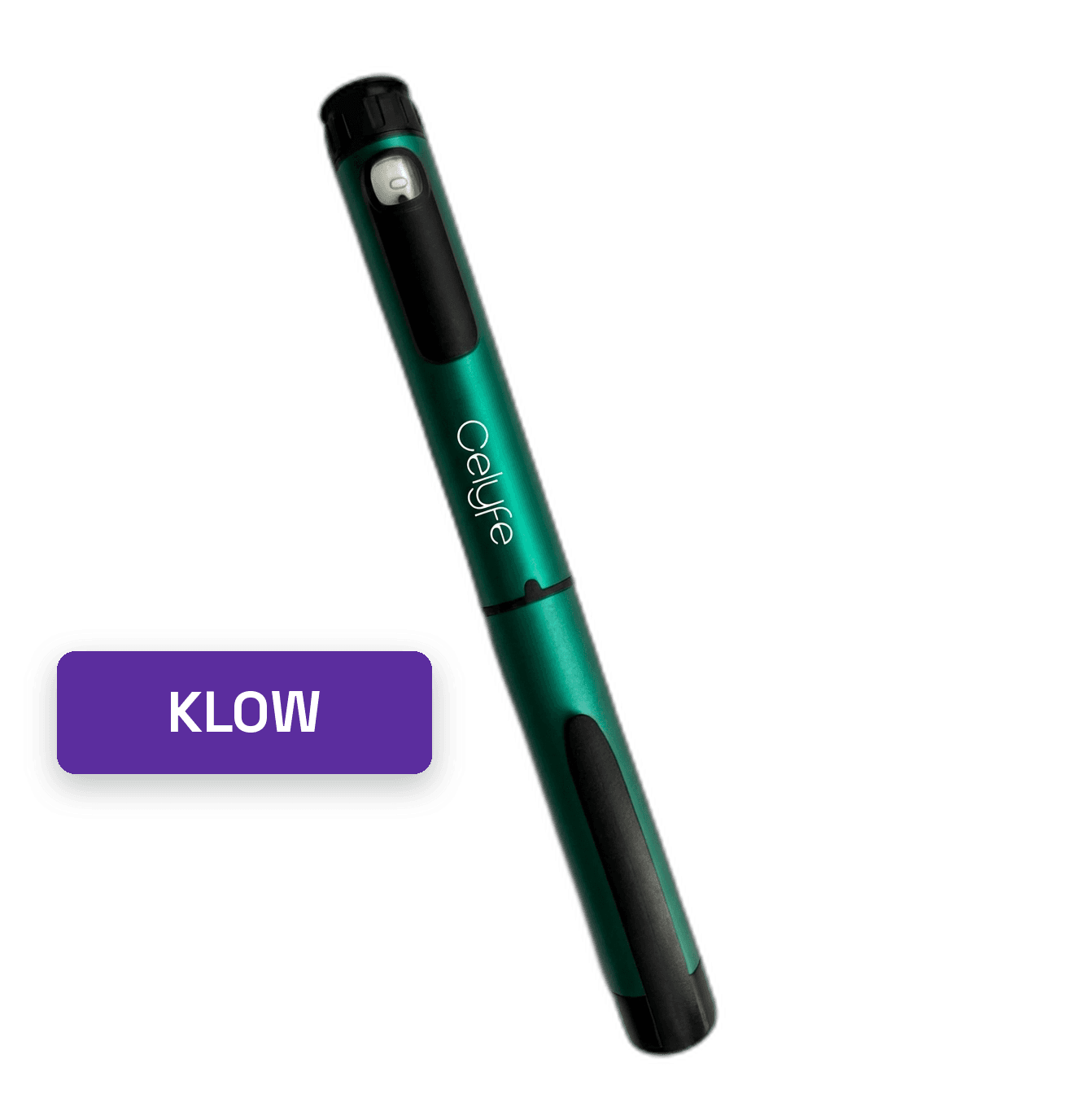
The GLOW Pen carries GHK-Cu, BPC-157 and TB-500, 105mg in total. The KLOW Pen is the same three compounds plus KPV, 120mg in total. KLOW is GLOW with an added alpha-MSH fragment for a four-pathway research set; GLOW is the three-compound version. Both are on sale now.
What is the GLOW Pen
GLOW is the market name for a three-peptide research blend of GHK-Cu, BPC-157 and TB-500 in one container. The Celyfe GLOW Pen holds 75mg of GHK-Cu, 15mg of BPC-157 and 15mg of TB-500 in a pre-filled 3ml cartridge, 105mg in total, and dispenses 0.350mg of the combined formulation per 0.01ml click across 300 clicks. The three sequences act on distinct pathways: copper-dependent signalling through GHK-Cu, peptide-signalling research through BPC-157, and actin-binding and cytoskeletal work through TB-500.
What is the KLOW Pen
KLOW is the supplier name for the GLOW set plus KPV; the K stands for KPV. The Celyfe KLOW Pen holds the same 75mg of GHK-Cu, 15mg of BPC-157 and 15mg of TB-500, with 15mg of KPV added, 120mg in total, dispensing 0.400mg per click across 300 clicks. KPV is the lysine-proline-valine tripeptide at the C-terminus of alpha-melanocyte-stimulating hormone, residues 11 to 13. Researchers use the three-residue fragment because it retains the sequence studied in inflammatory-signalling and NF-kB models while dropping the melanocortin-receptor pharmacology of the full hormone.
Key differences
From the two product pages:
- Components - GLOW: GHK-Cu, BPC-157, TB-500. KLOW: the same three plus KPV
- Total content - GLOW 105mg; KLOW 120mg, both in a 3ml pre-filled cartridge
- Per click - GLOW 0.350mg; KLOW 0.400mg, both at 0.01ml per click and 300 clicks
- Pathway families - GLOW covers three; KLOW adds a fourth, melanocortin-linked and inflammatory-signalling, through KPV
- Shared - GHK-Cu, BPC-157 and TB-500 are at identical masses in both pens
- Availability - both on sale now
Which pen carries which compounds
The three Celyfe combination pens are a ladder, each step adding one pathway family. A laboratory picks the smallest set that covers its question.
- WOLVERINE Pen - BPC-157 (15mg) and TB-500 (15mg). Two peptides, 30mg, 0.100mg per click
- GLOW Pen - the same two plus GHK-Cu (75mg). Three peptides, 105mg, 0.350mg per click
- KLOW Pen - GLOW plus KPV (15mg). Four peptides, 120mg, 0.400mg per click
How they fit together
The GLOW product page lists its applications as multi-peptide signalling and pathway-interaction studies, cytoskeletal and matrix-associated investigations, peptide-metal interaction work, and comparative analysis of individual versus combined peptide activity. The KLOW page adds four-pathway interaction studies in a single formulation and inflammatory-signalling models using KPV as the probe. The WOLVERINE Pen is described as the control-arm formulation for both.
Both share the same format and handling: pre-mixed with no reconstitution step, cold-chain delivery, refrigeration at 2 to 8 °C, never frozen, and dilution into a near-neutral buffer to preserve the copper complex. The GLOW and KLOW certificates are being re-issued and are not yet published, so no test result is claimed here for either pen. Every Celyfe pen is supplied and labelled for laboratory research use. Nothing on this page is guidance on use in humans or animals.
Key takeaways
- •The GLOW Pen carries GHK-Cu, BPC-157 and TB-500 (105mg total). The KLOW Pen is the same three compounds plus KPV (120mg total). KLOW is GLOW with an added alpha-MSH fragment for a four-pathway research set; GLOW is the three-compound version.
- •GLOW Pen: Pre-filled research pen, 105mg total.
- •KLOW Pen: Pre-filled research pen, 120mg total.
This comparison is informational and not medical advice. One or both entries are regulated compounds. Celyfe pens are supplied strictly for in-vitro laboratory research.
Side by side
Frequently asked questions
Sources
- GLOW Pen product page
- KLOW Pen product page
- Guide: What is the GLOW Pen?
- Guide: What is the KLOW Pen?
- Guide: What is KPV?
- Compound library: KPV
- Regenerative and Protective Actions of the GHK-Cu Peptide in the Light of the New Gene Data (International Journal of Molecular Sciences)
- Dalmasso G et al. PepT1-mediated tripeptide KPV uptake reduces intestinal inflammation. Gastroenterology, 2008. PMID 18061177
- Safer D et al. Thymosin beta 4 and Fx, an actin-sequestering peptide, are indistinguishable. J Biol Chem, 1991. PMID 1999398
- Peptides: Emerging Candidates for the Prevention and Treatment of Skin Senescence: A Review (Biomolecules)
- DeFoor MT et al. Injectable Therapeutic Peptides - An Adjunct to Regenerative Medicine and Sports Performance? (Arthroscopy, 2025, editorial commentary)
More comparisons